
If you are working in a technology organisation, you are quite certainly a part of some AI adoption initiative. Perhaps your organisation is training your individual developers, designers, product and even business people to make most of AI tools in their own work.
However, to get the returns on your AI-assisted software development investment at scale, then you should also look into your internal development platforms (not just your “Agent Platform”!). Additionally, you have to consider how your teams align and how well those teams, not just the individuals in those teams, are equipped to take advantage of the new AI tools they are given. As the recent DORA: ROI of AI-Assisted Software Development report says, you should not expect AI to be a silver bullet:
“The greatest returns on AI investment come not from the tools themselves but from a strategic focus on the underlying organizational system: the quality of the internal platform, the clarity of workflows, and the alignment of teams”
– Nathen Harvey, the DORA team lead at Google Cloud
All three of these things fit under the platform engineering umbrella:
- Quality of the internal platform
- Clarity of workflows
- Alignment of teams
The first one is obvious, and the other two pertain to the learnings from the Team Topologies book. Aligning teams to value streams and platforms that serve the needs of those teams, but not forgetting the important facilitating interactions between the teams. It’s easier to reason about a workflow when it’s not tribal knowledge, but embedded into shared platform tools and services. Optimisation stops being local, and instead we can look at larger chunks of the system. Instead of one developer being faster, we increase the flow for the entire value stream. Additionally, interactions with tools we can also measure instead of hoping for the best.
Internal Platform Economics Are Better Than Ever
It is no longer just developers building software. Domain experts can prototype, and sometimes also ship real production code. To do that confidently you need an internal platform that has security guardrails, strict boundaries, and observability baked in.
As acknowledged by the DORA report, some teams will find a new level of productivity, while others might struggle:
“Without a solid foundation built on quality internal platforms and clear workflows, AI merely generates isolated pockets of productivity.”
– DORA: ROI of AI-assisted Software Development report
If you want to scale that productivity you need to invest into internal platforms and platform teams that serve the organisation and provide a lever for multiple teams to move faster with confidence.
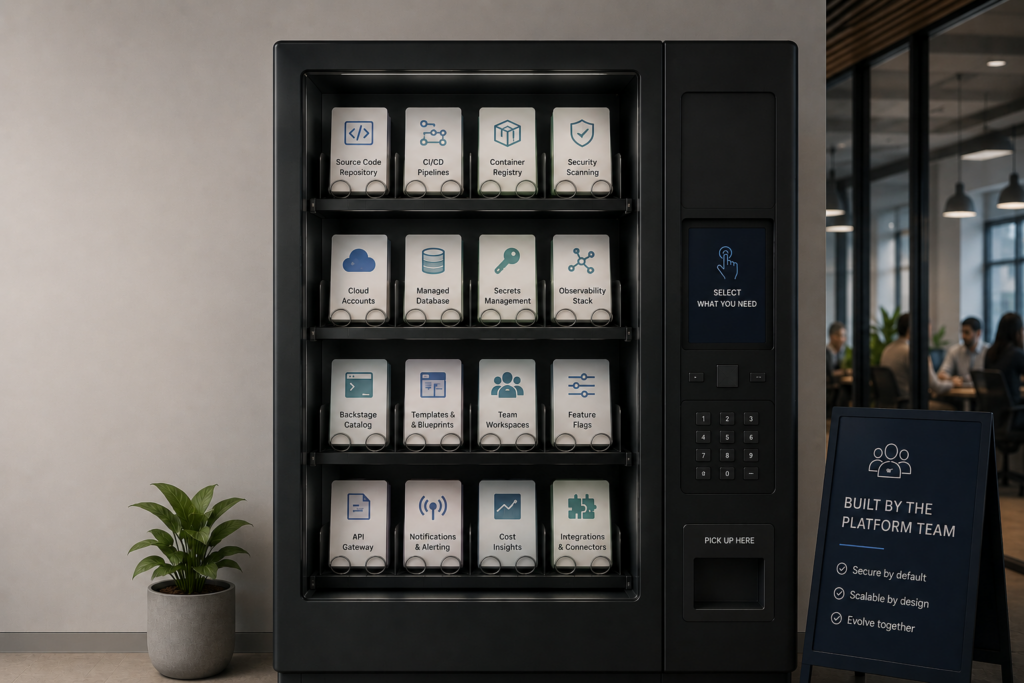
When a team discovers a new “secret sauce”, grab it and share it with the rest of the crew! Scale the production of the sauce and make it readily available from the platform vending machine. Don’t have each individual team invent the same wheel with slight variations that in time become hard to both maintain and replace.
Beyond AI Experiments
Creating more code faster than you can verify is not value, it is a liability. To avoid this, you want to build tight feedback loops. Throw away code for failed experiments quickly and focus efforts on the successful features to truly get ahead of the competition. Verification, or the lack thereof, is becoming a bottleneck when code is cheap to produce. Inefficient verification process will stall your delivery. Multiple handovers, defects caught only in the later stages and long feedback loops overall make your delivery clunky and frustrating. However, bypassing the process altogether will have you shipping garbage faster than ever.
Annoying thing with verifying your changes is that most likely you will have to ship that code, and if shipping code was always slow, AI won’t make you go any faster. Simple as that. You might be thinking; “Can AI help make the delivery faster?”. The answer is yes, of course, but what you don’t want is to locally optimise and end up in an anarchy where everyone has a different path to production in terms of tools and even technologies (underlying platforms).
Embedding Knowledge Into Tools
Giving every team the mandate to act according to a set of rules, is not the same as giving them a suite of automated checks that can enforce those rules in seconds during development instead of after the fact. Giving team rules to follow makes them go slower when they need to design to fit those rules (or if ignored, puts you at risk). Giving teams tools and services that already implement those rules liberates the teams to act within those boundaries, shipping value without risking a security incident or a production outage.
Let’s talk
This article was written by Lauri Suomalainen, Head of Cloud Development at Teamit, and Mike Vainio, Principal Cloud & Platform Architect at Teamit.
If you want to discuss how platform engineering can help your organisation scale AI-assisted software development safely and effectively, get in touch with Lauri, Mike or sales@teamit.fi.