

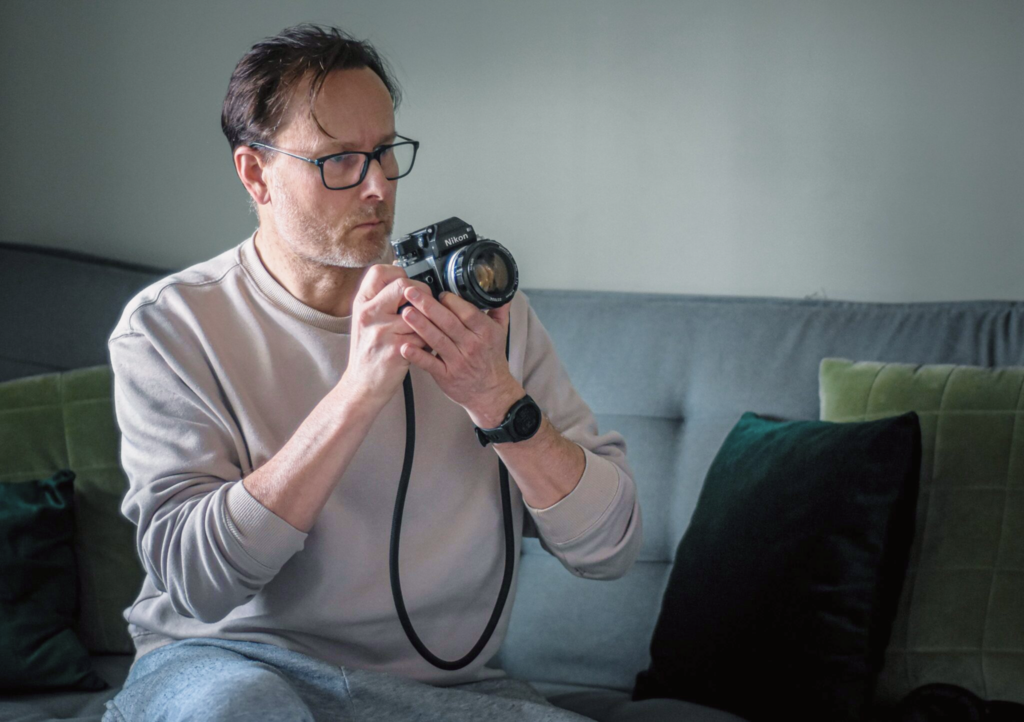
Jukka Jaakkola has spent his career following a simple instinct: understand how things really work. As a software architect at Teamit, he helps teams build systems that are technically sound and genuinely useful. Outside the office, he’s developing film in a darkroom and restoring vintage cameras. We sat down with him to hear how it all fits together.
Let’s start with the basics – who is Jukka Jaakkola?
I’m a software architect with a long background in software development and technology consulting. I enjoy understanding how systems work as a whole and helping teams build solutions that are both technically sound and genuinely useful for the business. I’d say curiosity is a big part of who I am – and that shows up both at work and outside of it.
How did you end up in software development in the first place?
It started with hands-on development. I’ve always enjoyed solving practical problems with code and understanding how systems behave under the hood. Over time I became more interested in the bigger picture – how systems fit together, how technology choices affect teams and organizations, and how architecture can support long-term development. That gradually led me into architecture roles.
What attracted you to Teamit specifically?
It was the combination of strong technical expertise and a very human-centric culture. I like working in environments where experts are trusted and where collaboration and knowledge sharing are genuinely valued. Consulting also offers the opportunity to see different organizations and challenges, which keeps the work interesting. No two clients are the same, and that suits me well.
What does your day-to-day work actually look like?
My work typically involves helping teams design and evolve systems, supporting development practices, and making sure the technical solutions align with business goals. But a big part of the work is also discussion and collaboration. Architecture is rarely about drawing diagrams alone – it’s about helping teams move in the same direction.
Is there a customer situation that has stayed with you as particularly rewarding?
One of the most rewarding situations is when a team moves from uncertainty to clarity. In one project, the biggest challenge wasn’t technology – it was understanding the real problem the system needed to solve. Once we aligned the technical design with the business context, development became much smoother and the team gained confidence in their direction. That shift, when people suddenly feel like they know where they’re going, is what I find most meaningful.
What does a good software architect bring to a customer?
Clarity, above all. That means understanding both the technical landscape and the business context, and helping teams make decisions that are sustainable in the long term. Equally important is enabling the team – architecture should support developers, not slow them down.
What’s a mistake you keep seeing again and again?
Starting from technology instead of the problem. It’s easy to get excited about frameworks or platforms, but architecture should always begin with understanding the business needs and the constraints of the environment. And honestly, once you truly understand the business context, you often realize that the best solution is not the most complex one – it’s the one that fits how the organization actually works.
Let’s switch gears a bit. I hear you’re into analog photography – what draws you to it?
It’s a nice contrast to software work. It’s slower and more physical: you load the film, take the photos carefully, develop the film yourself, and finally print the images in a darkroom. I enjoy both the creative side and the technical side of it. There’s something grounding about a process that can’t be rushed.
You also restore old cameras. What do you find interesting about that?
Old cameras are fascinating mechanical devices. When you repair or restore them, you really learn how precise and elegant the engineering can be. It’s a bit like debugging software — you investigate how the system works, find the root cause of the problem, and bring it back to working condition.
Do you see any deeper parallels between photography and software development?
Yes, actually. Both require a balance between technical understanding and creativity. In photography you think about light, exposure, and composition. In software development you think about architecture, structure, and clarity. In both cases the goal is to create something that works well and lasts. I hadn’t fully articulated it until someone asked me, but the connection feels very real.
What advice would you give to a developer who wants to move into architecture or consulting?
Stay curious and try to understand the bigger picture. Architecture is not only about technology – it’s about people, teams, and business goals. The more perspectives you understand, the more useful you can be. Pay attention to technical debt: learn to recognize it, communicate its impact in business terms, and make conscious trade-offs rather than letting it accumulate unnoticed.
What’s exciting you right now in your field?
I’m interested in how new tools – including AI-assisted development – are changing the way we build software. The pace of change is real. But at the same time, many of the core challenges remain the same: building clear, maintainable systems and helping teams work effectively. New tools don’t eliminate the need for good thinking; if anything, they make it more important.
And where would you like to take your career in the coming years?
I’d like to continue growing in roles where technology, architecture, and people leadership meet – helping teams succeed while building systems that stand the test of time. That intersection is where I feel most at home.
Read more about Teamit and check out our open positions: Career at Teamit